Learning Communities

Active Learning Classroom Communities

Dawson College, Montreal, Concordia University, Montreal, McGill University, Montreal

Active Learning Classroom Communities

About

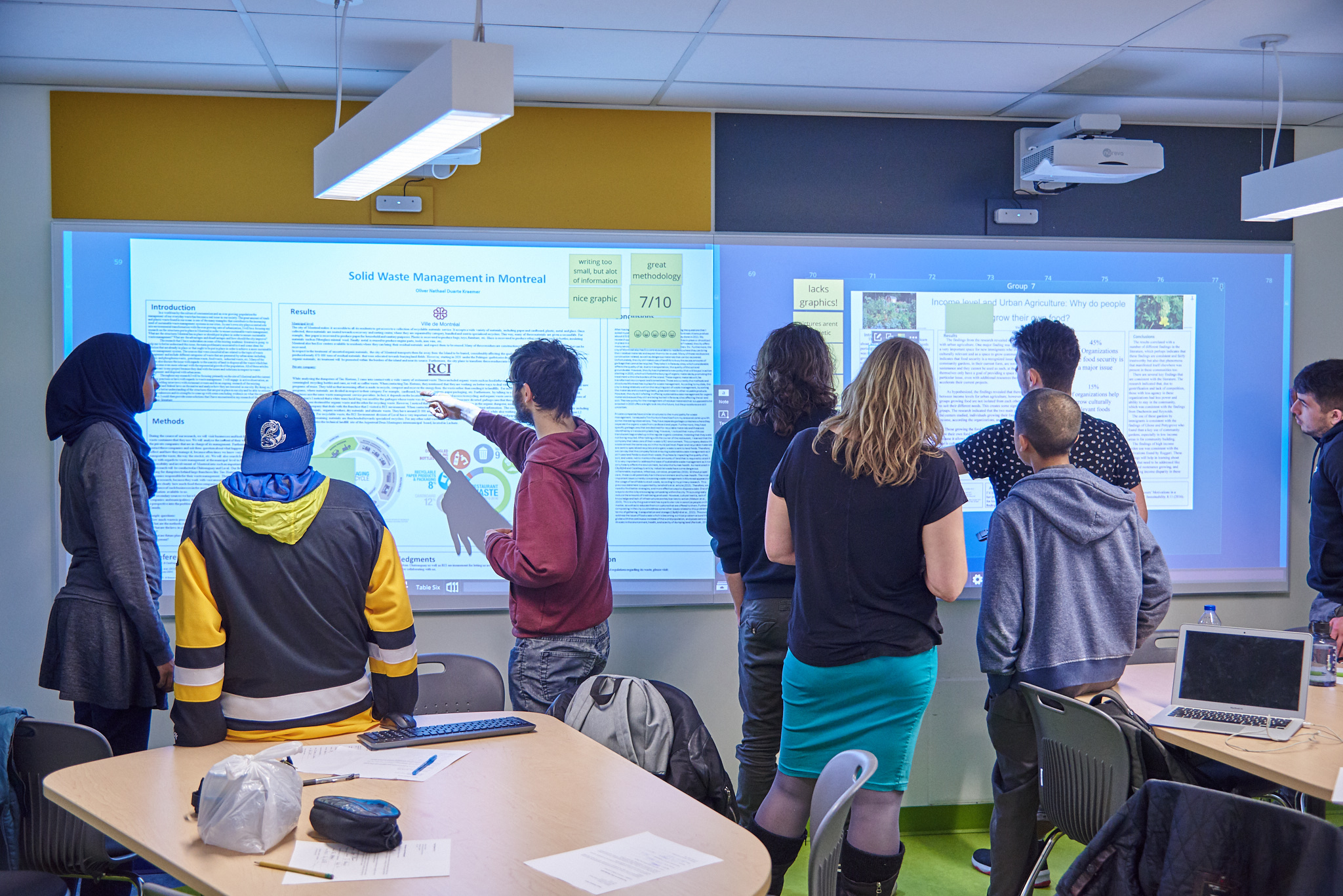
What are Active Learning Classrooms? Active Learning Classrooms (ALCs) are environments designed to foster student collaboration and enable the use of active learning pedagogies. An ALC can be either low-tech with no technology assistance or high-tech with computers brought into the room or installed. In both settings, educators use Active Learning strategies and approaches in their instruction.

What is Active Learning? Active Learning describes the types of instruction and pedagogy that calls for students to participate more fully with the course content. It requires teachers to develop new ways of getting students to …

Read More +

What are Active Learning Classrooms? Active Learning Classrooms (ALCs) are environments designed to foster student collaboration and enable the use of active learning pedagogies. An ALC can be either low-tech with no technology assistance or high-tech with computers brought into the room or installed. In both settings, educators use Active Learning strategies and approaches in their instruction.

What is Active Learning? Active Learning describes the types of instruction and pedagogy that calls for students to participate more fully with the course content. It requires teachers to develop new ways of getting students to reflect deeply on concepts, issues and problems that are key aspects of the course content (cognitive engagement), to engage respectfully with peers (social engagement) and to care about the process (emotional engagement). To achieve cognitive engagement, activities should take into account a range of thinking skills. This can be achieved by using Bloom’s taxonomy educational goals. It is made up of six hierarchical levels of learning objectives increasing order of complexity.

In addition, to achieve social engagement, activities should consider how to keep students working together collaboratively and use what are evidence-based strategies that elicit student interaction. This often means designing tasks that call for the development of mutual accountability and mutual responsibility. Not all active learning activities can elicit emotional engagement. But, if you can design an activity that draws the students into the work involved because its outcome serves a higher purpose (e.g., it can help someone) then you have something special!

Read Less -

More about Active Learning

Active Learning Classroom Communities - SALTISE members who have made contributions to research & design of AL classrooms.

Concordia University ALC

Active learning classrooms at Concordia’s Centre for Teaching and Learning, are formal learning spaces that are intentionally designed to promote optimal conditions for collaboration, group work, and flexible space configurations.

Dawson College ALC

The Dawson Active Learning Community (DALC) is a group of Dawson faculty and staff from a variety of disciplines. The aim of the DALC is to improve teaching and learning through evidence-based Active Learning (AL) pedagogical practices, the development, design and effective use of complementary educational technologies.

McGill University ALC

The ALCs at McGill were developed under the supervision of the Teaching and Learning Spaces Working Group (TLSWG). This working group used the National Survey of Student Engagement (NSSE) benchmarks of effective educational practice to develop the Principles for Designing Teaching and Learning Spaces.

How to Create an Active Learning Classroom

Principles for Successful Active Learning Classrooms (ALC)

Read More +

Principles for Successful Active Learning Classrooms (ALC)

1. Evidence-based Pedagogy always comes first.

2. Technology and design should be used to support learning.

3. Don’t try to make one room do everything – build a diverse toolkit of rooms.

4. Expansion plans should be iterative – based on research and evidence.

5. Assemble a design team that involves those who have taught in the ALC.

6. Developing a Learning Community around the ALC promotes the effectiveness of its use.

7. Scheduling in ALCs that recognizes the investment made by teachers using those spaces is important.

Read Less –

Furniture that Works

Read More +

Furniture that Works

1) Tables for effective collaboration:

a. It doesn’t seem to matter if it’s one big table or several smaller tables that can be linked together without gaps. That said, the rooms where we saw one big table, designed for the purpose of promoting collaboration because of its size and shape seems to work particularly well.

b. Ideal size of grouping seems to be between 4 to 7. Below 4 and the chances of one or two students not showing up or being prepared is high leaving groups too small. Above 7 and the group seems to split into two.

c. Tables that don’t have obstacles (e.g., desktop computers) that obstruct the line of sight between students or large dead-spaces in the middle (like large circular tables) seem to promote collaboration between members of the group.

d. Ideal number of table groupings seems to be between 6-8 groups. This gives teachers the best opportunity to observe and manage each group’s work.

2) Chairs on wheels:

a. Active Learning means that students need to become engaged in the classroom activities, therefore, they are encouraged to move frequently. Having chairs on wheels reduces the noise involved in moving and makes it easy to get in and out of seats. It also facilitates movement around the room by allowing people and chairs to get out of the way.

3) Large public writable surfaces (whiteboards & interactive whiteboards):

a. Writable surfaces seem to be most useful when they are large (greater than 48” wide) and can accommodate at least 4-5 students working as a group.

b. Writable surfaces appear most effective when there is a way to identify the board as dedicated for a specific group – i.e., group boards helping to develop a sense of belonging.

Read Less –

Placement of Furniture

Read More +

Placement of Furniture

1) Tables should be positioned away from walls:

a. Students are more likely to collaborate around their artifacts when they can have access to the whiteboards, which are generally attached to the walls. Therefore moving tables away from the walls is most effective for collaboration.

b. Floor-patterning (using colours for example) can be used to delineate a “buffer” zone around the perimeter of a room.

2) Writable surfaces location:

a. Be aware that corners can be particularly difficult location for boards if two groups are positioned side-by-side. Options that seem to work: (1) eliminate the sharp corner with a diagonal board; (2) assign both sides of the corner to one group.

b. Retractable projection screens seem to take away writing spaces. Therefore consider using materials that can be both projection screen and writable surface.

3) General comment about layout:

a. The teacher has better access to groups when the layout of the furniture is in a horseshoe design. This design also appears to leave sufficient room for students and teacher to move easily around the room.

b. Where possible avoid a room design that differentiates group proximity and access to writeable surfaces. For example, where possible, avoid having some groups sitting next to their writeable surfaces while other groups are sitting in the middle of the room with another table in between them and their writeable surface.

Read Less –

Selection of Spaces to convert into ALC

Read More +

Selection of Spaces to convert into ALC

1) Ideal shape of classroom:

a. It appears that square room shapes are better than long rectangular shapes. Long rooms make it difficult for the class to work together and benefit from the sharing of the public artifacts.

2) Location of multiple ALCs:

a. Building ALC in close proximity (i.e., creating an ALC “zone”) seems to facilitate the development of a community of practice (learning community). Doing so shows that teachers can turn to each other for help, particularly when there is technology involved.

b. Building ALC in close proximity seems to make the job of the IT staff easy.

3) Other factors:

a. Noise levels in ALCs can get loud. Acoustic dampening materials should be considered in the furniture or other.

b. Consider using lighting to designate group work spaces.

c. Consider additional ventilation when including multiple interactive whiteboards and/or projectors (they generate significant heat).

d. Teachers and students report preferring to have at least some windows in the ALC, even when the window light requires blinds from time to time.

e. Consider cost of markers and refills.

f. Teachers need to have a space where they can put books/notes and if and interactive whiteboard is dedicated for teacher use, a surface for a keyboard and mouse may be necessary. A small, easily moveable stand seems to be preferable.

Read Less –

Things to Avoid

Read More +

Things to Avoid

1) Tables (furniture) against the walls – make less free space for students to work on the boards as a group and creates congestion.

2) Table sizes that are too large – group work best when the group size can accommodate contribution from each member with adequate diversity.

3) Limit the use of hard surfaces particularly on the ceiling. While acoustic tiles on the ceiling will dampen the noise it doesn’t seem enough.

4) Avoid too many built-in objects on table tops – e.g., desktop computers.

Read Less –

Resources on ALC

International AL Classrooms

On the international front, members of the Learning Sciences have taken a scholarly approach to investigating and expanding knowledge on the topic learning spaces, they refer to these as Future Learning Spaces. This group is considering the theory, methods, design and implementation of such spaces. North Carolina State University (NCSU), Massachusetts Institute of Technology and Dickinson College have lead the way in designing ALCs with projects such as SCALE-UP and TEAL Technology-Enhanced Active Learning. A key example of how such learning spaces can become an integral part of an institution’s classroom inventory is the University of Minnesota, they have constructed 14 ALCs in their Robert H. Bruininks Hall building. They host an annual event on the design and development of ALCs, the International Forum on Active Learning Classrooms.

Other Resources

Check out our Articles & Books section and select the “Learning Environments” category to find additional documentation.