Jigsaw
"Jigsaw is a peer exercise that quickly gets students working together, developing expertise, and learning how to explain for understanding."
What is it?
Jigsaw is an instructional strategy that starts by creating different areas of expertise within small groups of students. This expertise is then shared with other students to assemble the sum of their knowledge into a greater whole. Using a jigsaw strategy promotes knowledge assembly, critical thinking and synthesis on a topic (task or complex problem).
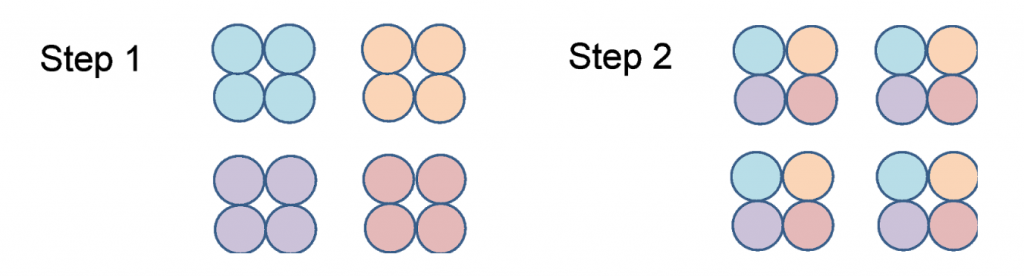 It starts by breaking a large topic (task or complex problem) into sub-topics and assigning a different sub-topic to each group. Each group works together to research/investigate their sub-topic to become an ‘expert’ group of individuals (Step 1). The expert individuals are then re-grouped into new groups, comprised of several different sub-topic experts (Step 2). Each sub-topic expert presents their information, and, together they integrate their individual knowledge into the new group’s collective understanding, usually with the goal of completing an assignment.
Take a look at the workflow below to see how Jigsaw is structured and implemented in the classroom.
Skills Promoted
- Analytical reasoning
- Communication
- Knowledge integration
- Team work
- Co-regulation
- Time management
Who's using it?
SALTISE community members who use this strategy and are willing to share advice and/or resources.
| Institution | Discipline | Instructor | Classroom settings |
|---|---|---|---|
|
Concordia University Level: University |
Social Sciences |
Traditional Classroom Classroom size: All sizes |
|
|
Concordia University Level: University |
Biology |
Traditional Classroom Classroom size: All sizes |
|
|
University of Guelph Level: University |
Environmental Science |
Traditional Classroom Classroom size: 30 |
|
|
McGill University Level: University |
Engineering |
Traditional Classroom Classroom size: 75-95 |
|
|
John Abbott College Level: College |
Physics |
Active Learning Classroom Classroom size: 30-40 |
| Institution |
Concordia University Level: University |
Concordia University Level: University |
University of Guelph Level: University |
McGill University Level: University |
John Abbott College Level: College |
|---|---|---|---|---|---|
| Discipline |
Social Sciences |
Biology |
Environmental Science |
Engineering |
Physics |
| Instructor | |||||
| Classroom settings |
Traditional Classroom Classroom size: All sizes |
Traditional Classroom Classroom size: All sizes |
Traditional Classroom Classroom size: 30 |
Traditional Classroom Classroom size: 75-95 |
Active Learning Classroom Classroom size: 30-40 |
Why use it?
- Jigsaw is a effective way to replace a content-heavy lecture with an activity that is more engaging and encourages deeper thinking.
- Students enjoy becoming “subject experts” and are very enthusiastic about teaching their peers. Allowing them to teach each other gives students a sense of responsibility and shared learning.
- The benefits of a Jigsaw activity enables students to investigate everyday devices (or topics) they use to develop core competencies in a course.
- In addition active learning helps students explore these competencies in a very interactive and stimulating way.
- For some students this activity may not be suitable if they have difficulty performing peer-instruction.
- Another drawback is depending on students to deliver the concepts of the course.
- Sometimes there can be misconceptions or mistakes that can make it confusing for students trying to learn from other students. Furthermore, if there is a weak group, the topic doesn’t get covered as well as other topics.
Ready to try it out?

Strategy Workflow
Related Activities




Helpful resources
References
Perkins, D. V. and Saris, R. N. (2001). A “jigsaw classroom” technique for undergraduate Statistics courses. Teaching of Psychology.
Gömleksi, M. N. (2007). Effectiveness of cooperative learning (jigsaw II) method in teaching English as a foreign language to engineering students (Case of Firat University, Turkey). European Journal of Engineering Education, Taylor & Francis..
Karacop, A. and Doymus, K. (2013). Effects of jigsaw cooperative learning and animation techniques on students’ understanding of chemical bonding and their conceptions of the particulate nature. Journal of Science Education and Technology, Springer..
Doymus, K. (2008). Teaching chemical bonding through jigsaw cooperative learning. Research in Science & Technological Education, Taylor & Francis.
Lai, C. Y. and Wu, C. C. (2006). Using handhelds in a jigsaw cooperative learning environment. Journal of Computer Assisted Learning, Wiley Online Library.
Videos
Using Jigsaw With Texts – Harvard University, Derek Bok Center for Teaching and Learning, Social sciences discussion
TO LEARN MORE
For more resources go to Articles and Books